
How to use the Rubik's Cube solver
Solving a scrambled cube with the solver takes four steps. You don't need to know any algorithms: the program works out the moves and shows you how to make them.
1. Enter the colors of your cube
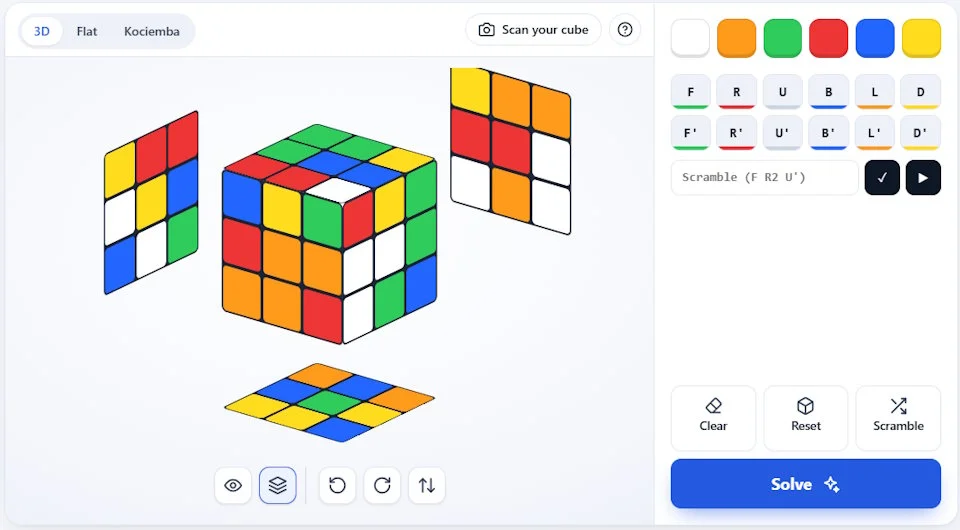
Hold your cube so that its center colors match the cube on the screen: white center on top, green center facing you. The centers never move, so they tell you where every other sticker belongs.
Pick a color from the palette, then click each sticker of that color. You can also click a sticker repeatedly to cycle through the six colors. Clear empties all stickers if you prefer to start from a blank cube, and Reset brings back the solved cube.
The quickest way to enter a scramble is the camera scanner: show each face to your webcam or phone camera and the colors are read for you.
2. Check every face
The 3D view shows three faces at a time. Turn the whole cube with the rotate buttons under it, or with the left and right arrow keys, to see the others. The eye button makes the front faces see-through, and the layers button lifts the hidden faces away from the cube so you can check all six at once.
Prefer a flat picture? The Flat and Kociemba tabs unfold the cube so that every sticker is visible together, which makes it easy to compare with the cube in your hands.
3. Press Solve
When the screen matches your cube, press Solve. The solver first checks that every color appears exactly nine times and that the six centers are different. On the solution page it also catches the problems a single wrong sticker can cause: a flipped edge, a twisted corner or two swapped pieces.
The solution opens in a new tab, so your scramble stays put if you need to go back and correct a sticker.
4. Follow the moves
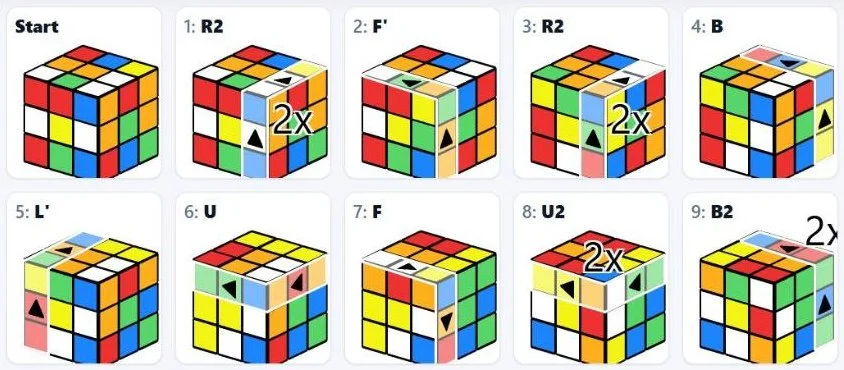
Hold the cube in the same position you used to enter the colors, then press play, or step through the moves one at a time. Every move is also drawn as a small picture with arrows, from the starting position to the solved cube. A 2x label means a half turn of that face.
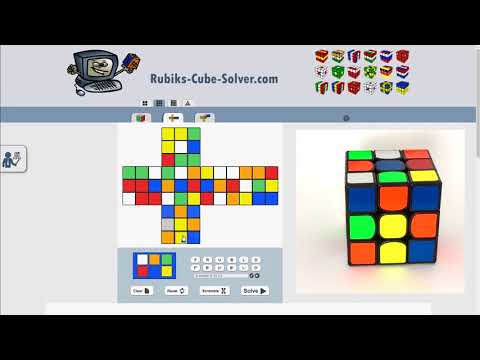
Prefer to watch? This short video walks through the same steps. It was recorded with an earlier version of the site, so the buttons look different, but they work the same way.
Play with the cube online
The solver doubles as a virtual Rubik's Cube. Press Scramble for a random mix and try to solve it yourself with the face-turn buttons, or with the F, R, U, B, L and D keys on your keyboard. Each button turns one face a quarter turn clockwise; the buttons with an apostrophe (F', R' and so on) turn it counterclockwise. For a full-screen virtual cube, try this online Rubik's Cube simulator.
To set up a known position, type a sequence of moves in the scramble field, for example R U R' U'. The tick button applies it at once and the play button animates it move by move. An apostrophe or a lowercase letter means a counterclockwise turn, a 2 means a half turn, and slice moves (M, E, S) and whole-cube rotations (X, Y, Z) work too.
How the solver finds the solution
The program uses Herbert Kociemba's two-phase algorithm, the method behind his Cube Explorer software. The first phase brings the cube into a position that can be finished with a restricted set of moves; the second phase finishes it with those moves. The search keeps combining the two phases until it finds a short overall solution.
Every position of a 3x3 cube can be solved in 20 moves or fewer, counting a half turn as one move. This limit, known as God's Number, was proven in 2010. The solver aims for a solution of that length; if your device would need too long to find one, it settles for up to 24 moves instead.
All of this runs in your browser. Before searching, the program builds its lookup tables, which takes from a few seconds to a minute or two depending on your device.
Why does it say my cube is impossible?
Not every arrangement of stickers is a real cube position. If a cube has been taken apart and put back together at random, there is only a 1 in 12 chance that it can still be solved: an edge may be flipped, a corner twisted, or two pieces swapped in a way that no sequence of turns can undo.
Most of the time, though, the message simply means a sticker was entered wrongly, so compare the screen with your cube face by face. If every sticker is right, the cube itself needs fixing: take it apart and reassemble it in the solved position. Read more about unsolvable Rubik's Cubes.
What do the letters in the solution mean?
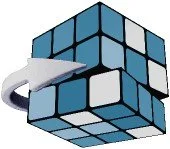
D: down face clockwise
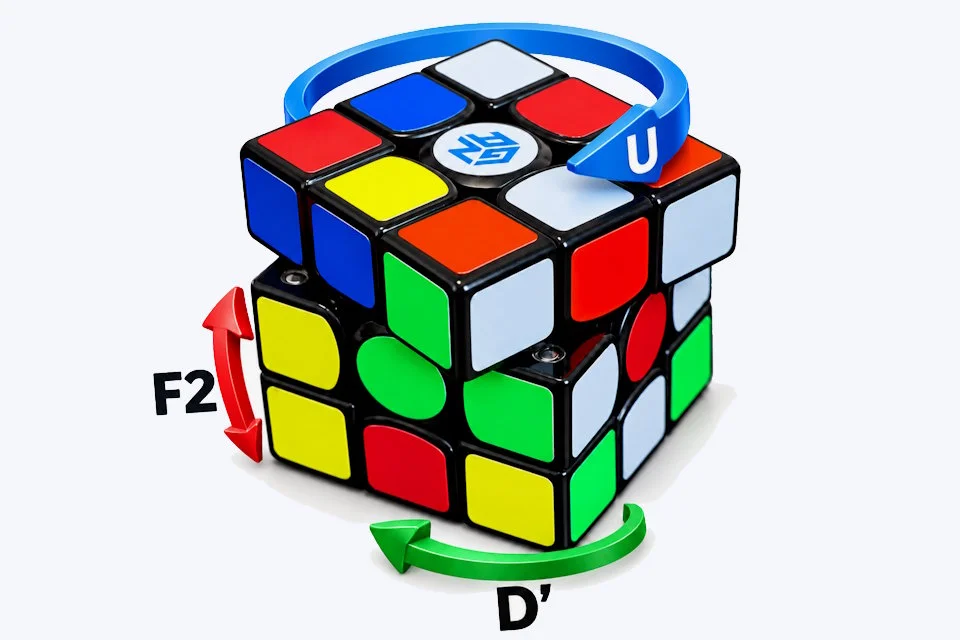
Each letter stands for one face of the cube: F (front), B (back), U (up), D (down), L (left) and R (right). A letter on its own means a quarter turn clockwise, as seen when you look straight at that face. An apostrophe (R') means counterclockwise, and a 2 (R2) means a half turn.
The notation guide in our beginner's tutorial shows every move with pictures.
Learn to solve the Rubik's Cube yourself
The solver gets you out of trouble, but learning a method is more rewarding, and easier than it looks. Our beginner's guide to solving the Rubik's Cube builds the cube layer by layer in six steps, with pictures for every case and only a handful of algorithms to remember. The Ruwix cube wiki covers the puzzle's history, records and advanced methods.
Frequently asked questions
Is the Rubik's Cube solver free?
Yes. It runs in your web browser on computers, tablets and phones, with nothing to install and no account to create.
How many moves does the solution have?
Usually 20 or fewer. On slow devices the solver may return a slightly longer solution, up to 24 moves, rather than keep you waiting.
Why doesn't it just undo my scrambling moves?
The solver doesn't know how your cube was mixed. It only sees the current position and finds its own short route back to the solved cube.
Can it solve a 2x2, a 4x4 or a Pyraminx?
There are separate tools for those: the 2x2 Pocket Cube solver, the Pyraminx solver and the 4x4 Rubik's Revenge solver.